
Ever wondered about the guy who masterminded the Americanization of English spelling? Here with a guest post us about him is Adam Simpson, writer of the wonderfully energetic and eclectic ‘One year in the life of an English teacher’ blog. Over to Adam…
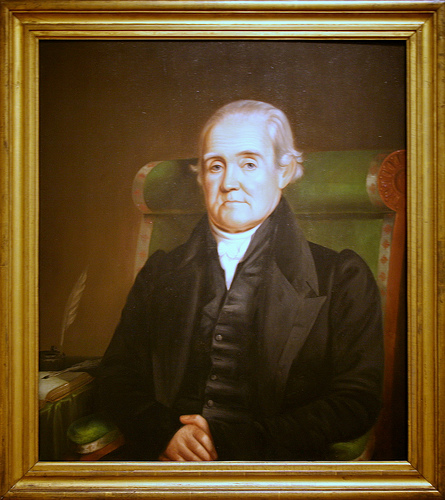
By: Cliff
At the tail end of the eleventh century, the Byzantine emperor Alexios I wrote a letter pleading Pope Urban II for ‘hired muscle’ in the fight against the Muslim advances into the Byzantine Empire. The direct result of this letter was a series of religiously sanctioned military campaigns, waged by much of Roman Catholic Europe, with the aim of restoring Christian control of the Holy Land. These campaigns, which would come to be known as the Crusades, would continue being fought over a period of nearly 200 years. What does all this have to do with us as English language teachers? Well, it shows us the effect of one person’s written work, and how the repercussions of such writings may still be felt centuries later.
Although, thankfully, much less of a bloodbath has (so far, at least) resulted from his collected documentation than that of Alexios I, the words that Noah Webster put down in writing made him the archetypal language Crusader, one whose actions are still very much being felt today. For Noah, you see, was the founding father of the phenomenon we refer to as American English (thus, by default, making him also the founder of modern British English).
Webster was quite the man; an American lexicographer before such a thing existed, a textbook pioneer who thought that Americans should learn from American books, (resulting in his compendium, A Grammatical Institute of the English Language), an English spelling reformer, a political writer, an editor, a slavery abolitionist and a prolific writer to boot. Basically, it’s not for nothing that Webster is referred to as the father of American scholarship and education. In essence, it’s very much down to him that his country folk might nowadays say, ‘He de man!’ Indeed, such has been Webster’s influence on the language that in the United States his name is synonymous with the very notion of ‘dictionary’. Consider this: Webster was seventy years old when the 70,000-word An American Dictionary of the English Language was first published in 1828. What should have been his magnum opus actually sold very poorly: only 2,500 copies. This didn’t deter the septuagenarian, who even had to re-mortgage his home to be able to finally publish the expanded second edition. Although he died with his language reform work still relatively unrecognized, it would all pay off eventually. Today the world knows the contemporary version of this volume as the Merriam-Webster dictionary, the Merriam brothers having bought the rights to the name after Webster’s death in 1843.

Slowly but surely, over the course of the inconceivable 385 different editions that were published during his lifetime alone (with many more after he died), Webster effectively ‘Americanized’ the spelling of words in the ways that we know and love today. For example, he quickly chose s in place of c in words like offense and defense, he changed the re to er in words like center and theater, and he even dropped one of the Ls in traveler. Other things would take longer to get the Webster treatment: he kept the u in words like colour or favour for a long time, but eventually dropped it in later editions. Although it seems so simple now, Webster didn’t take this task lightly. He purposefully learned twenty-six languages, including Old English, German, Greek, Latin, Italian, Spanish, French, Hebrew, Arabic, and Sanskrit so that he could evaluate the etymology of words.
Evolution teaches us that isolated populations will eventually evolve to the point that they share little with their common ancestor. While modern communications mean that the world’s islands of English are now inseparable in a way that has never previously existed with languages that have managed to span the globe, we can still see the influence that this exceptional man had on the evolution of the language. So, every time you are asked about the differences between American and British English, you know who to blame!
Further reading
‘Noah Webster’ in The Cambridge History of English and American Literature in 18 Volumes (1907–21). Vol. 18 section 25:33 http://www.bartleby.com/228/0233.html
Ellis, Joseph J. 1979, After the Revolution: Profiles of Early American Culture. Ch. 6 http://www.questia.com/PM.qst?a=o&d=101499638
Thanks for very much for this piece, Adam! I have to say I’m impressed by some of Webster’s spelling rationalizations though I need to keep practising. I used to write a column for a local newspaper here where my British spellings caused havoc. When I wrote about things like my neighbours, travelling, the theatre, changing a tyre, wearing pyjamas and honouring cheques, they said it paralysed their computer programme.
[…] This post was mentioned on Twitter by Karenne Sylvester, BC Kumar. BC Kumar said: N is for Noah (Webster) | Learning to speak 'merican […]
Great to put him into context Adam, didn’t know his first name and didn’t know when he lived and died. Really appreciate this kind of post, it makes us all think and is an extra piece in that ELT puzzle that none of us will ever finish….
Hi Adam – what a fascinating piece – I really enjoyed it! You can’t beat a bit of brisk history on a Sunday evening.
Cheers,
Tony
Thanks for the comments and again to Vicki for agreeing to post my ramblings on her fine blog. Trust me, researching and writing up this piece was an education and a joy.
[…] https://www.merican.vickihollett.com/?p=3213 […]
Freaking fantastic post, Adam. Loved it so much read it twice.
K
[…] If you’re interested in how the differences in spelling conventions came about, please read this guest post I wrote for Vicki Hollett’s blog on the work of Noah Webster. […]
[…] If you’re interested in how the differences in spelling conventions came about, please read this guest post I wrote for Vicki Hollett’s blog on the work of Noah Webster. […]
[…] If you’re interested in how the differences in spelling conventions came about, you might like to read this guest post I wrote for Vicki Hollett’s blog on the work of Noah Webster. […]